
Weaving Water
Installation at Sou'wester Art Seaview WA July - September 2026

To what water do you belong?
All life on Earth comes from water. It is in constant conversation with the moon in a rhythmic tidal pull that calls forth the dance between rest and action. It operates by its own special rules, transcending what it means to be a solid, liquid, or gas. It is cooperative by nature, molecules linking together to make the capillary action within trees possible. It floats as a solid, it rises into the sky as a gas in billowing clouds, enacting an ever changing play containing everything which can be imagined.The great cycle from sky to mountain to river to sea to sky again, sustains the land. Water is truly life.
A reverence for water is easy to understand. Ancient cultures all across planet Earth have viewed rivers as living beings, often feminine. Sacred springs have provided solace and healing to generations. I recently heard of an ancient European tradition of Mother Rivers, a way of honoring that water way nearest where you were born. Diving into this tradition I have learned that such traditions, recognizing rivers as goddesses, can be found all over.
As trade expands to the global, our dependence on waterways also expands beyond the local. If the cotton in the shirt you wear is grown in India, than that mother river used to irrigate the cotton becomes a River you are in relationship with, just as the water in the reservoir or well which flows forth from the tap in your home, is precious, so too these other unknown Relational Rivers which nourish the lands which meet your needs are precious.
We live in a time in which we commonly bottle and wrap water in plastic, then allow those bottles to pollute the sea. We have learned to accept the “inevitable” pollution of certain water as an unfortunate necessity to our life. Laws and public policy have allowed for water to be privatized in dangerous ways. Ideas like these provide evidence of our disconnection from water’s deeply sacred nature.
This installation is a sanctuary for water, and is an invitation to reconnect to the waters which nourish, and sustain us. Perhaps you have already heard the water calling you?
Interacting with Weaving Water
There are two ways to interact within this installation beyond simply observing it. The Tributary Book, and the Community Water TalismanTapestry.
The Tributary book is a place to document and make tribute to the waters that provides you with your life. What water do you know? What is the nearest river to where you were born, or where you sleep now? What is the name of your home watershed? What water nourishes the field where your food is grown? Is there a spring or pond, lake or ocean which speaks to you? Is there a high mountain lake which you dream of years after visiting it?
Use the book to name these sources of water which we hold dear. Name the waterways which you know, or call in the unknown rivers and springs, to document and honor them. You may feel inspired to write only names, or perhaps you are called to write down a snippet of memory, a haiku, a little drawing, prose or tiny story along the indigo blue current line which runs along all the pages. Please treat this book as a sacred container to hold our collective regard and respect. Making tangible our ineffable love of life-giving waters.
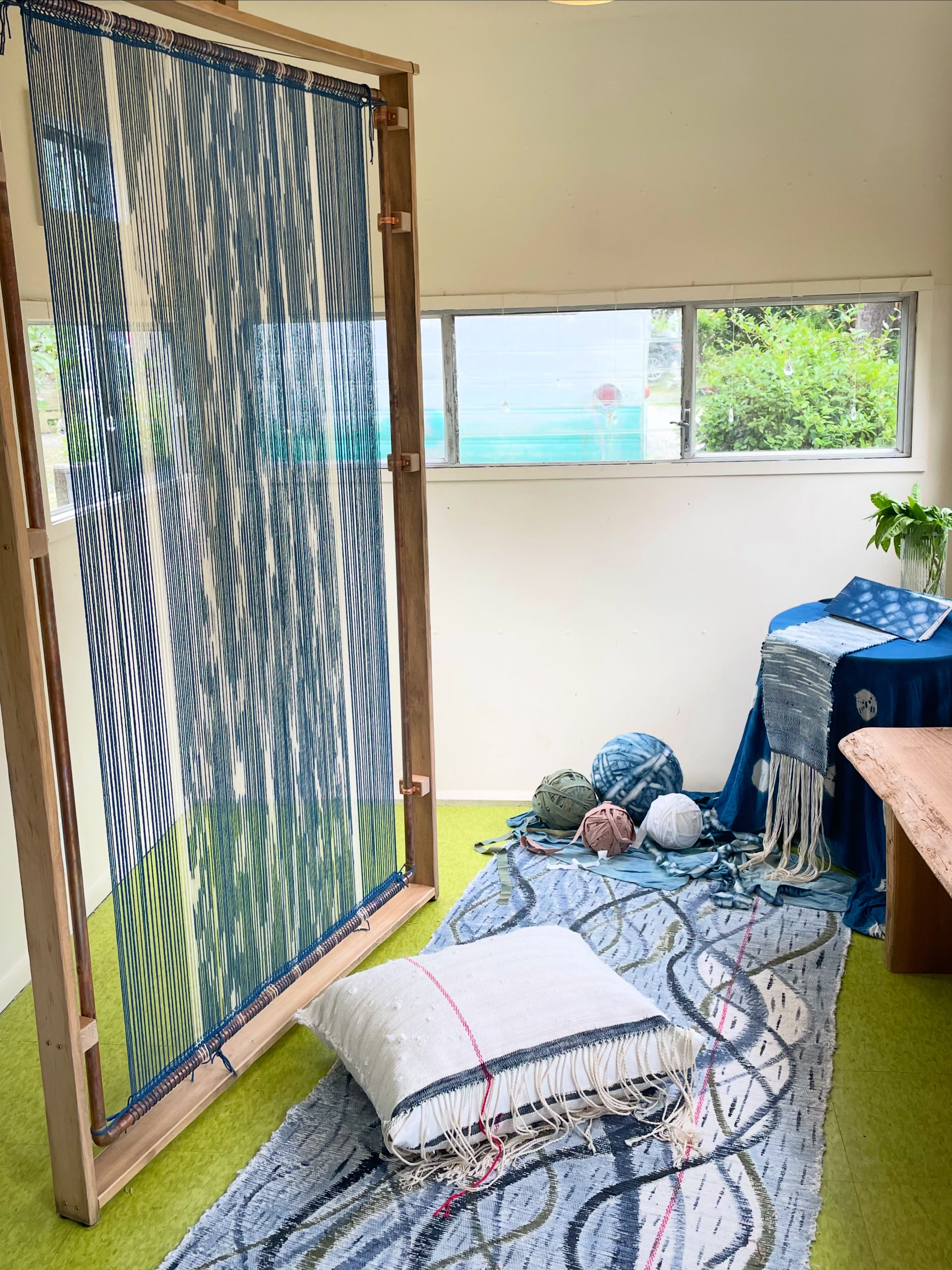
Once you have connected to a specific source of water, I invite you weave a symbol of it into the Community Water Talisman Tapestry. First choose one of the balls of ribbon made from sheets. Measure a section of ribbon using your own body as a ruler. This is intuitive, perhaps choose the distance from nose to tip of finger, or the length of your leg. Use the scissors in the diatom basket to cut off your chosen length. This piece of dream ribbon is your weft to weave into the warp on the tapestry loom. Feel free to untie any knots in the ribbon, or leave them in as texture. Weave this weft over and under the individual warp threads. The pointed madder dyed stick my help you find a path, or simply use your fingers. You may use the horse comb to tamp down what you have woven.
If you hold the water you belong to in your heart as you weave, you make the invisible visible. Weaving need not be linear - this community tapestry will evolve - we are weaving together a collective talisman for healthy watersheds.
Consider how water finds a way through and around obstacles, consider how water can wear away stone. By aligning with water, by choosing to become protectors of water, we affirm that water is part of all life, and ought not be exploited or polluted. Let us weave together a blessing for all of the waters of the world. Let us offer our desire to protect water everywhere.
Material Concerns: an explanation of objects within this sanctuary
The blue in this exhibition is all sources from US Grown natural indigo pigment.
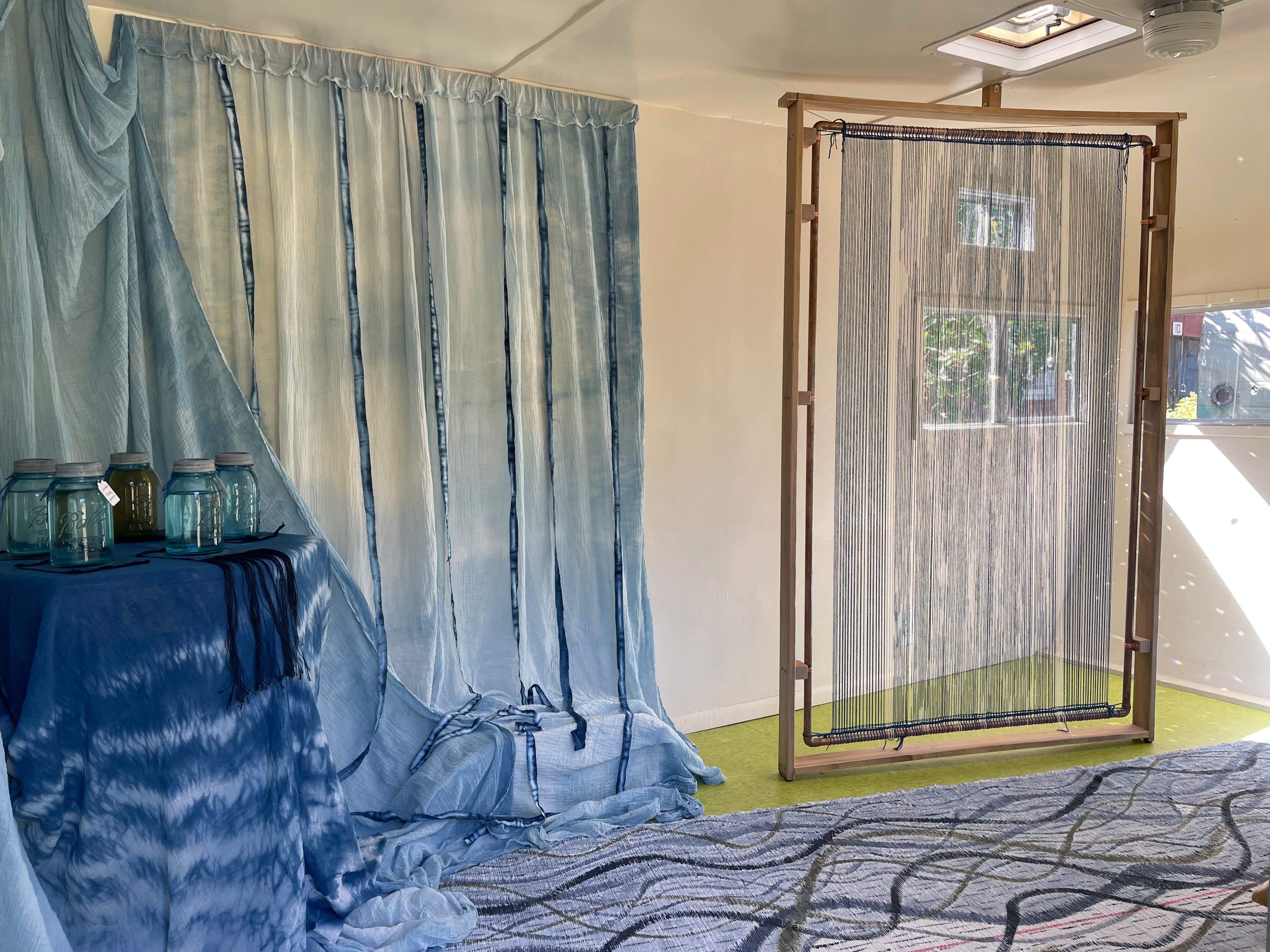
The question door rug, river rug, cascade table runner, and weaver’s floor pillow, were all handwoven on the same warp using a traditional countermarch floor loom. The weft is of discarded Sou’wester sheets - literally woven dreams.
The red line, seen on all but the table runner, refers both to setting a boundary, and to life itself. There is a practice of tying a red thread on the wrists of a circle of women, while awaiting the birth of a baby, as a symbol of solidarity and anchoring spiritual power to energetically assist with the birth from afar. We have reached a time in which collectively we are called to give birth to a new way, a new society which nourishes rather than exploits. We need to hold the line on the exploitation of water especially. Connecting to the water which gives us life, will instill the responsibility to protect and honor all water.
The river rug was painted with homegrown indigo pigment, homemade Maya Blue pigment, and yellow ochre.The indigo pigment used was created from the plant, Persicaria tinctoria, a temperate climate indigo bearing plant used throughout Eastern Asia. It is a riparian zone plant in the buckwheat family, this is the plant in the vase on the west table holding the river book
The cascade table runner weft was resist dyed with indigo prior to weaving to simulate light glinting on water.
The hardbound Tributary book has indigo dyed linen book cloth, and recycled paper pages. The painted end papers and river line ink are both from homegrown indigo.
The headwaters altar contains five jars of water from places important to Iris. (Special thanks to Ginger Edwards for bringing me water from Mount Shasta.) Each jar rests on a hand woven ramie and silk moon coaster. The cotton gauze table cloth and walls were also dyed with indigo.
The diatom basket holds the tools for weaving in it. The cloth lining the basket has a stylized diatom on one side and four purple Martin silhouettes on the other. Diatoms are microalgae, and though nearly invisible, are essential to life on our planet. Living within water in both oceans and soils. They are incredibly diverse and exquisitely beautiful, and provide much of the oxygen we breathe. Purple Martins are to honor the Martins which live in the same neighborhood Iris lives in, their melodious calls while flying over the water bring great joy..
The copper tubing crown which holds the top of the headwater cascade references drinking fountains, which is a common use for such tubing. The water which quenches our thirst is precious from its origin to where ever it rejoins the sea. It is for this reason which I believe that it is deeply inappropriate for water to be privatized.
The tapestry loom is made of copper and maple. Copper pipe referencing human relationship to water that is often piped to faucets through copper in our homes. This pipe was sourced from a salvage yard. The warp is ikat resist dyed to reference ripples in water. The balls of dyed sheet material ribbon is intended to be used as weft in the loom. Dyes used for the sheets include: indigo, sitka spruce tannin, and osage orange wood. My deep gratitude to my Husband Joe Garrison for putting together the loom from my design.
Artist Watershed Bio
I was born in Gladwin County Michigan, homeland of the Ojibwe Peoples. The Cedar River is the closest river to where I was born. The Cedar, Sugar, Little Sugar, Tobacco, and Molasses are all Relational Rivers of my home county, and all flow into the Tittabawassee River, which in turn flows into the Saginaw river, joining Lake Huron, Lake Erie, into the Saint Lawrence River, flowing over Niagara Falls and eventually joining the Atlantic Ocean. All of these rivers of my home county are tea colored due to tannin flowing through fallen leaves of the hardwood forests.
At twenty I moved to the lands of the Kalapuya peoples in Lane County Oregon, where the Mckenzie meets the Willamette River. It was in that county that I eloped with my husband Joe, standing with our bare feet in the water of Shotgun Creek. All of these waters flow towards the mighty Columbia River. After graduation from University of Oregon, We followed the water, moving to the homeland of the Chinook and Clatsop Peoples in Astoria, and settling on the banks of Columbia River Estuary, where river water is embraced by the salty sea, and the tidal shifts can be as much as ten feet. Bear Creek Watershed near Svensen supplies drinking water to Astoria.
Like you, there are many many more unknown watersheds that tangibly provide me life.
Iris is a fiber artist who works with natural color and installation. She holds a BFA from UO, and teaches art to humans. Whole hearted thanks to my husband Joe, and sons Sam & Tully, who provided significant help with this installation. Gratitude to Sou’wester Arts for all they do to nourish art on the coast.This installation is part of a series of seasonal interactive exhibitions created as part of the Sou’wester Arts Installation Fellowship.
Iris is the cofounder, along with Britt Boles, of Indigofest, an annual art retreat celebrating indigo dyeing from plant to cloth. Indigofest happens at the Sou’wester each August.
Her website: https://www.dreambirdstudio.com/
Indigofest: https://www.indigofest.org/
Gorgeous! The words, the weaving, the water. I miss you. ❤️